
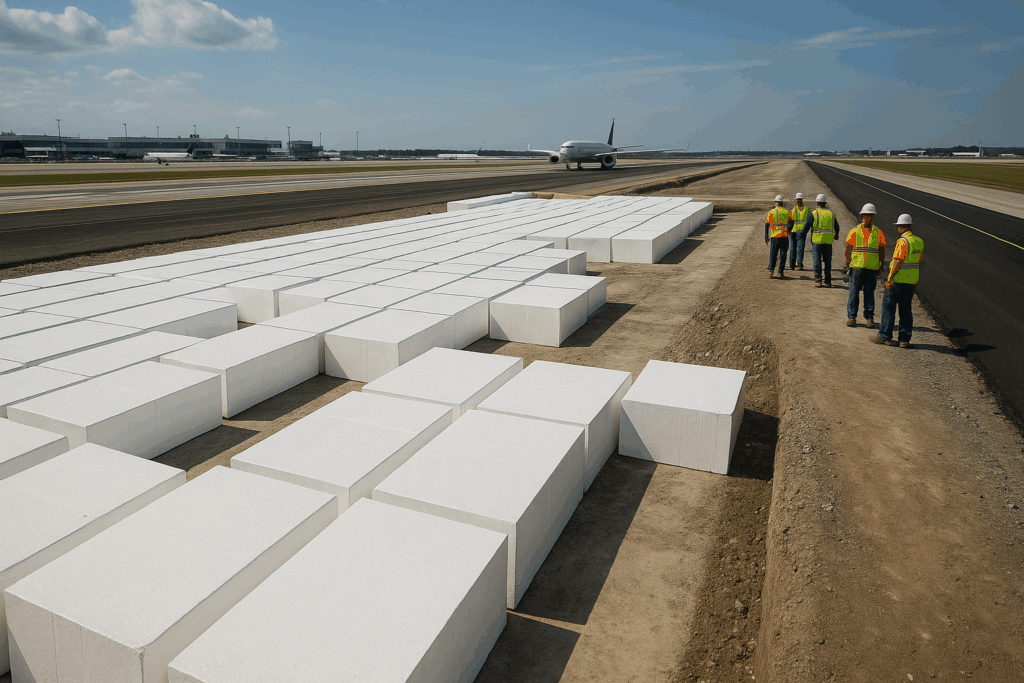
Lightweight Structural Fill for Critical Transportation Infrastructure
EPS Geofoam is rapidly becoming the go-to solution for engineers working on airport and railway construction. With increasing demand for faster project delivery, long-term stability, and reduced settlement, Geofoam offers an innovative, engineered alternative to traditional fill materials—especially in high-traffic, soft-soil, or constrained environments.
Whether you’re expanding a runway, constructing a high-speed rail bed, or stabilizing subgrade for new terminals, EPS Geofoam delivers strength without weight. It simplifies logistics, reduces construction time, and supports the performance standards required for modern aviation and rail systems.
Why Geofoam Works for Airports & Railways
- High Load-Bearing Capacity, Minimal Weight
Geofoam provides stable, predictable compressive strength while weighing as little as 1% of traditional soil fill. This drastically reduces lateral and vertical loads, making it ideal for use over buried utilities, soft soils, or near structures.
- High Load-Bearing Capacity, Minimal Weight
- Fast, Predictable Installation
Geofoam blocks are delivered precut and stacked, ready for immediate installation. No waiting on compaction, curing, or moisture conditioning. This leads to faster turnarounds and minimized project delays.
- Fast, Predictable Installation
- Reduces Settlement Risk
Airports and rail systems are particularly sensitive to subgrade movement. Geofoam is dimensionally stable and resists long-term settlement, helping avoid costly maintenance or slab replacement later.
- Reduces Settlement Risk
- Simplifies Utility and Tunnel Crossings
EPS Geofoam is frequently used to backfill over culverts, storm drains, or train tunnels due to its low weight and ease of shaping. It allows structural engineers to meet loading requirements without overburdening buried infrastructure.
- Simplifies Utility and Tunnel Crossings
- Excellent for Soft Soil Conditions
Geofoam allows you to build stable ground in areas where soft, unstable soil would otherwise require deep foundations or time-consuming preloading. It eliminates the need for surcharge loading or wick drains in many cases.
- Excellent for Soft Soil Conditions
- Compatible with Airport & Rail Standards
Geofoam complies with FAA, AASHTO, and ASTM D6817 standards. Its inert composition makes it safe for use near sensitive signaling, fuel systems, and underground cabling.
- Compatible with Airport & Rail Standards
Technical & Installation Overview
Design Features:
-
- Cut-to-Fit Panels Blocks can be pre-cut or trimmed on-site to match elevations, curves, or transitions—ideal for forming ramps, slopes, or rail beds.
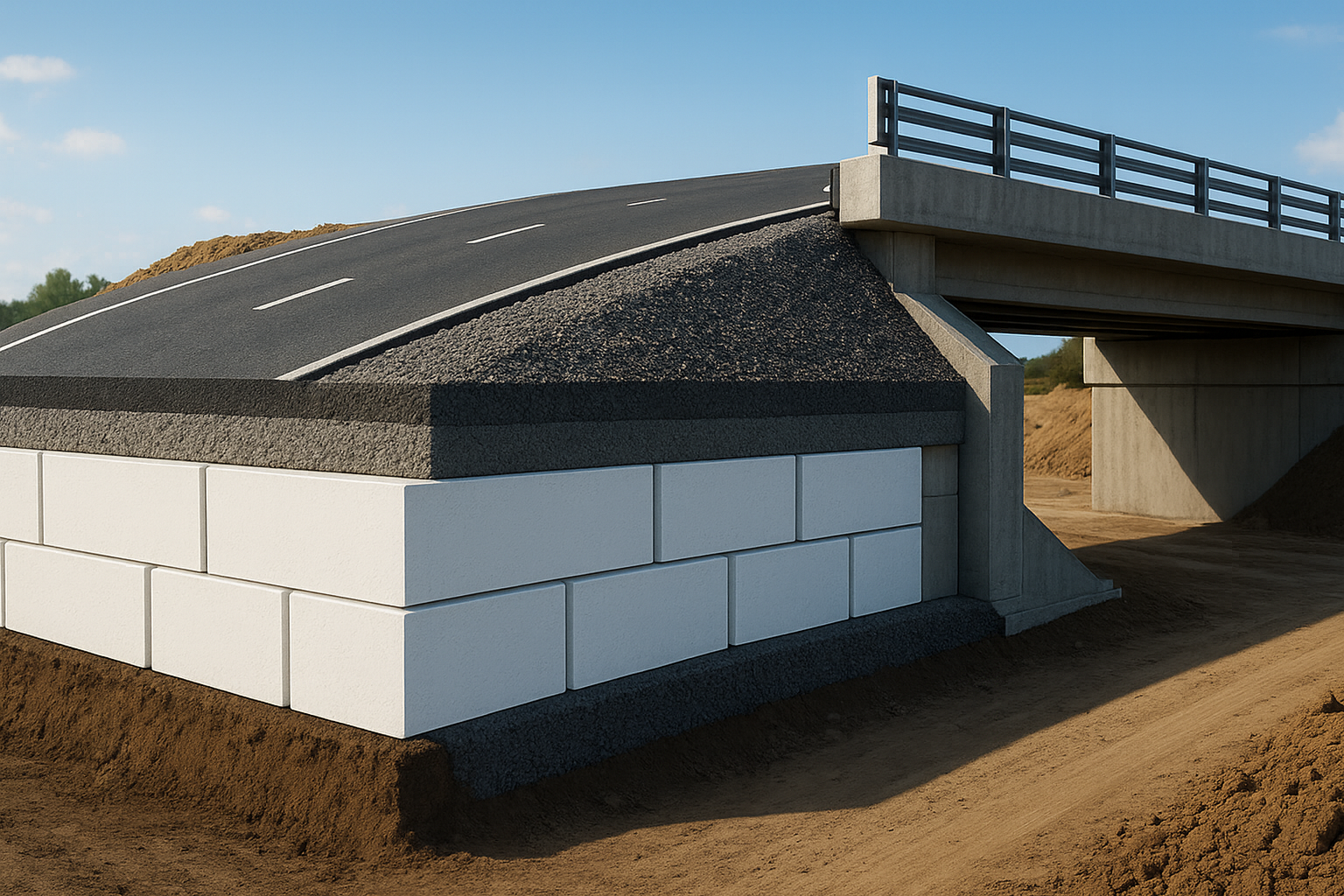
- Stacked & Staggered Configuration Geofoam is typically placed in multiple staggered layers to distribute load and prevent linear seams or shear planes.
- Protective Cover Layers Concrete slabs, ballast, or geotextile membranes are often installed above Geofoam to protect from UV, water, or fuel exposure.
- Minimal Site Disruption Since Geofoam requires no heavy equipment, it’s ideal for projects in active terminals, downtown rail corridors, or maintenance-sensitive areas.


Applications in Airports & Railways
In a major railway corridor upgrade in the Pacific Northwest, Geofoam was used to construct a new embankment over soft, compressible peat. Traditional fill would have caused unacceptable settlement, but EPS blocks allowed for immediate track installation and cut construction time by 6 weeks, saving over $500,000 in soil prep and surcharge costs.
EPS Geofoam has been used in hundreds of airport and railway projects around the globe—from runway rehab projects in the U.S. and Canada to high-speed rail beds in Asia and Europe. Its performance, predictability, and ease of use make it a compelling choice for today’s infrastructure demands.
Runway and Taxiway Expansion
EPS Geofoam provides lightweight fill beneath airport runways and taxiways, reducing differential settlement and providing stable support for aircraft loading zones. It’s ideal when building over utility corridors or unstable ground.
Rail Track Subgrade Stabilization
Used beneath rail ballast or embedded track systems, Geofoam improves grade stability and reduces subgrade pressure—especially valuable in areas with expansive clays, landfill zones, or variable soils.
Terminal and Station Platforms
Geofoam helps form elevated platforms, sloped walkways, and access ramps without the need for heavy equipment or deep foundations. It offers quiet, vibration-dampening performance in high-traffic passenger areas.
Embankments Near Structures
Building rail or airport embankments near retaining walls, bridges, or existing buildings can be challenging due to lateral pressure. Geofoam offers a lightweight backfill alternative that protects adjacent structures.
Utility Crossings & Tunnel Cover
Used to backfill over utility corridors, stormwater systems, or tunnels, Geofoam reduces cover weight without compromising structural integrity.
Benefits for Contractors, Engineers & Agencies
- Rapid installation accelerates timelines
- Reduces site access and equipment costs
- Prevents settlement in sensitive zones
- Safe for use near aviation fuel lines and electronic systems
- Approved by FAA, AASHTO, and ASTM
- Lower environmental impact vs. traditional fill
- Easy to shape for ramps, cross-sections, and transitions
Ready to Reinforce Your Next Transit Project?
Whether you’re building up to code for FAA-grade runways or shoring up light rail platforms, EPS Geofoam offers a lightweight, reliable, and cost-effective solution. It’s the trusted choice for transportation engineers looking to accelerate projects without compromising performance.
Contact us today for technical data, material specs, or a quote tailored to your airport or railway application.