
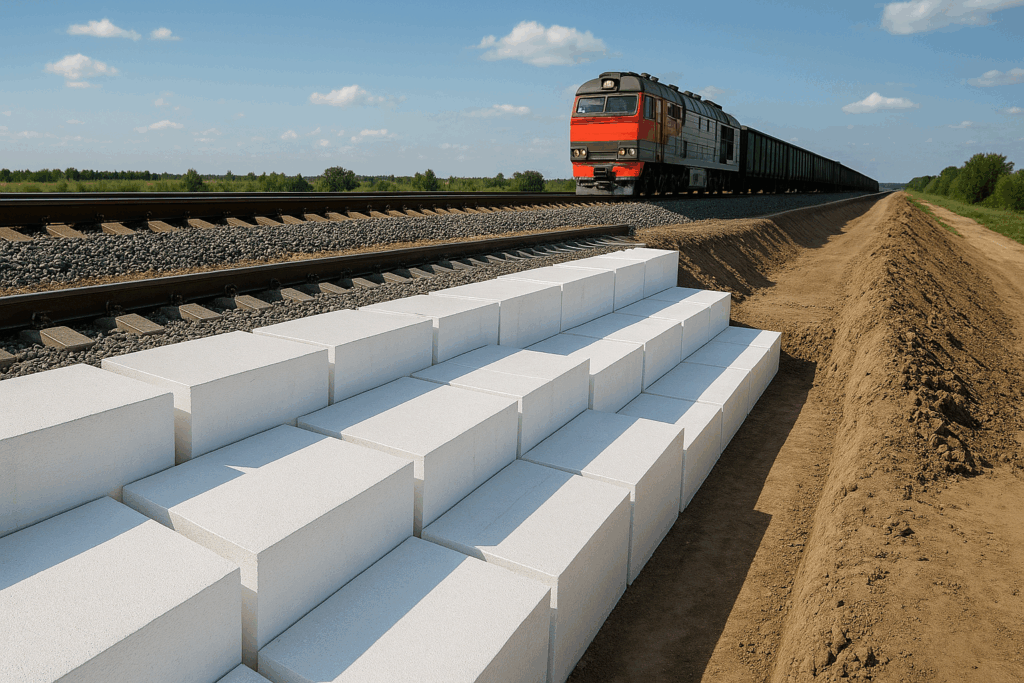
Lightweight Stability for Modern Rail Systems
EPS Geofoam is a superior alternative to traditional soil or aggregate fill in the construction of railroad embankments, particularly in areas with soft soil, poor drainage, or limited right-of-way. Its ultra-lightweight yet load-bearing design allows for the safe elevation of track beds, control of settlement, and accelerated construction timelines.
WhetherWhether you're working on high-speed rail systems, light rail, or freight corridors, Geofoam can eliminate many of the geotechnical risks associated with conventional embankment design. It supports consistent track alignment, minimizes long-term maintenance, and adapts to the challenging terrain often encountered in rail development.
Why Geofoam Works for Railroad Embankments?
- Lightweight Fill for Poor Soils
Traditional embankments built with compacted soil or stone can overload soft ground, leading to differential settlement and structural instability. Geofoam weighs less than 2% of soil, reducing the pressure on subgrade and eliminating the need for deep foundations or soil stabilization.
- Lightweight Fill for Poor Soils
- Faster Construction, Fewer Delays
Unlike soil fill, which must be placed in lifts and compacted, Geofoam is delivered pre-cut and can be installed rapidly. This speeds up embankment construction, particularly in weather-sensitive or access-constrained environments.
- Faster Construction, Fewer Delays
- Reduces Differential Settlement
Uneven settlement can cause rail alignment issues and safety hazards. Geofoam’s dimensional stability and predictable compressive strength make it ideal for building embankments that maintain their geometry long-term.
- Reduces Differential Settlement
-
- Controlled Geometry and Slope Design Geofoam blocks can be custom-cut to create precise embankment slopes, step-outs, and transitions. This ensures that engineered slopes meet design standards without the need for complex grading or formwork.
-
- Reduced Lateral Loads Near Structures When building embankments near bridges, retaining walls, culverts, or buildings, Geofoam limits lateral pressure that would otherwise compromise adjacent structures.
-
- Cost Savings Through Efficiency Faster installation and reduced earthwork requirements mean lower labor, equipment, and hauling costs. Geofoam’s performance benefits often translate to reduced lifecycle maintenance for the track system.
Design & Installation Considerations:
-
- Layered Block Configuration Blocks are stacked in offset patterns to create embankment slopes or vertical lifts. Joints are staggered for structural continuity.
- Geotextile & Protection Layers A geotextile fabric or geomembrane may be placed above the Geofoam to separate it from the ballast or sub-ballast layer and prevent contamination.
- Track Structure Integration The final railbed can include ballasted track, slab track, or direct-fixation rail systems depending on design requirements.
- Surface Load Distribution Where heavy axle loads are anticipated, concrete or geogrid panels can help distribute surface loads and protect the Geofoam layer.

Applications in Airports & Railways
In a rail upgrade project for a major Class I freight carrier, engineers used Geofoam to construct a 12-foot-high embankment over clayey soil with high moisture content. Traditional soil would have required wick drains and six months of surcharge preloading. Geofoam reduced the construction schedule by 8 weeks, eliminated ground improvement costs, and allowed track installation to begin immediately after embankment construction.
Geofoam is gaining popularity among transportation agencies, civil engineers, and contractors for its reliability and long-term performance in embankment systems. Its value lies not just in what it does—but in what it prevents: track distortion, uneven settlement, high maintenance costs, and construction delays.
Soft Soil Crossings
Geofoam allows track systems to pass over marshes, wetlands, peat bogs, or unstable fill without triggering major settlement or requiring deep foundation piles.
Elevated Track Embankments
Use Geofoam to safely elevate rail lines in flood zones or areas requiring elevation change, without adding excessive weight to underlying soil.
Approach Fills for Rail Bridges
Build lightweight approach ramps to bridges with minimal risk of settlement at the abutment, improving long-term ride quality and reducing deck joint damage.
Urban Rail Transit
In tight spaces with underground utilities or older infrastructure, Geofoam is a lightweight alternative that avoids overloading buried systems while still delivering stable support for rail.
Track Realignments or Retrofits
During rail improvement projects, Geofoam enables elevation or slope adjustments with minimal excavation and disruption to surrounding areas.
Technical Advantages
- Compressive Strength: Meets or exceeds ASTM D6817 standards for load-bearing under live and dead rail loads.
- Inert Material: Chemically stable, moisture-resistant, and non-reactive with rail ballast or metals.
- Temperature Stable: Performs reliably in freeze–thaw conditions, flood zones, and all climates.
- Sustainable: 100% recyclable and free from CFCs or HFCs. Reduces emissions from hauling heavy fill materials.
- Light Equipment Friendly: Blocks can be installed by hand or small equipment, ideal for remote or narrow-access rail corridors.
Ready to Reinforce Your Rail Project?
EPS Geofoam is the smart solution for new and existing railroad embankments—lightweight, stable, and engineered to perform. It reduces design risk, simplifies construction, and supports safe, efficient rail transport for decades to come.
Contact us today to discuss how Geofoam can support your next railroad infrastructure project.